
How to Search Lubbock County Court Records
Most Lubbock County court records start at the county's Online Access to Court Records service. The county runs a free Public Access portal that holds County Clerk and District Clerk case data. The official Lubbock County government site is the gateway to every court department, and it links out to the portal, the clerks, and the courts. Justice of the Peace records are not in the portal yet. The county says JP records will be added as the system grows.
Before you start, gather what you know. A full party name helps. A case number helps more. The portal gives the case index, general case details, parties, attorneys, and scheduling data. It does not show document images for a standard user. For images and older files, you use courthouse terminals or ask the clerk.
- Open the Public Access portal and create a free registered account. You must validate your email within three days.
- Pick the court or clerk. Right now County Clerk and District Clerk records are live.
- Enter a party name or a case number. District Clerk case numbers use hyphens for cases filed after August 2021.
- Review the case index, parties, attorneys, and hearing settings.
- For a document image or a certified copy, visit a courthouse terminal at 904 Broadway or request a copy from the clerk.
The county homepage shows the department gateway used to reach each court office.

From that homepage you can reach the judiciary directory, the clerks, and the Public Access sign-in used for a Lubbock County Court records search.
Court Records Search Fields
The portal asks for a few key fields. The table below lists what the county describes for registered public access.
| Field Label | Type | Required | Notes / Format |
|---|---|---|---|
| Registered account | Account | Yes | Free sign-up; validate email within three days. |
| Court / clerk | Dropdown | No | County Clerk and District Clerk are live; JP records are planned. |
| Case number | Text | No | Hyphens required for district cases after August 2021. |
| Party name | Text | No | Returns the case index and party list. |
| Attorney | Text | No | Registered access includes attorney data. |
The Lubbock County Judicial System
Texas has a layered court system, and Lubbock County uses most of it. District courts are the trial courts of general jurisdiction. Lubbock County is served by the 72nd, 99th, 137th, 140th, 237th, and 364th District Courts. County Courts at Law #1, #2, and #3 handle misdemeanors, civil cases, probate, and family matters by statute. Four Justice of the Peace precinct courts handle small civil claims, evictions, fine-only offenses, and traffic. City municipal courts handle local ordinance and traffic tickets.
Appeals from the district and county courts go to a Texas Court of Appeals. Civil cases can go on to the Supreme Court of Texas. Criminal cases can go on to the Texas Court of Criminal Appeals. The Texas judiciary explains this structure on its public court pages.
The state judiciary site lays out how trial courts and appeals fit together statewide.
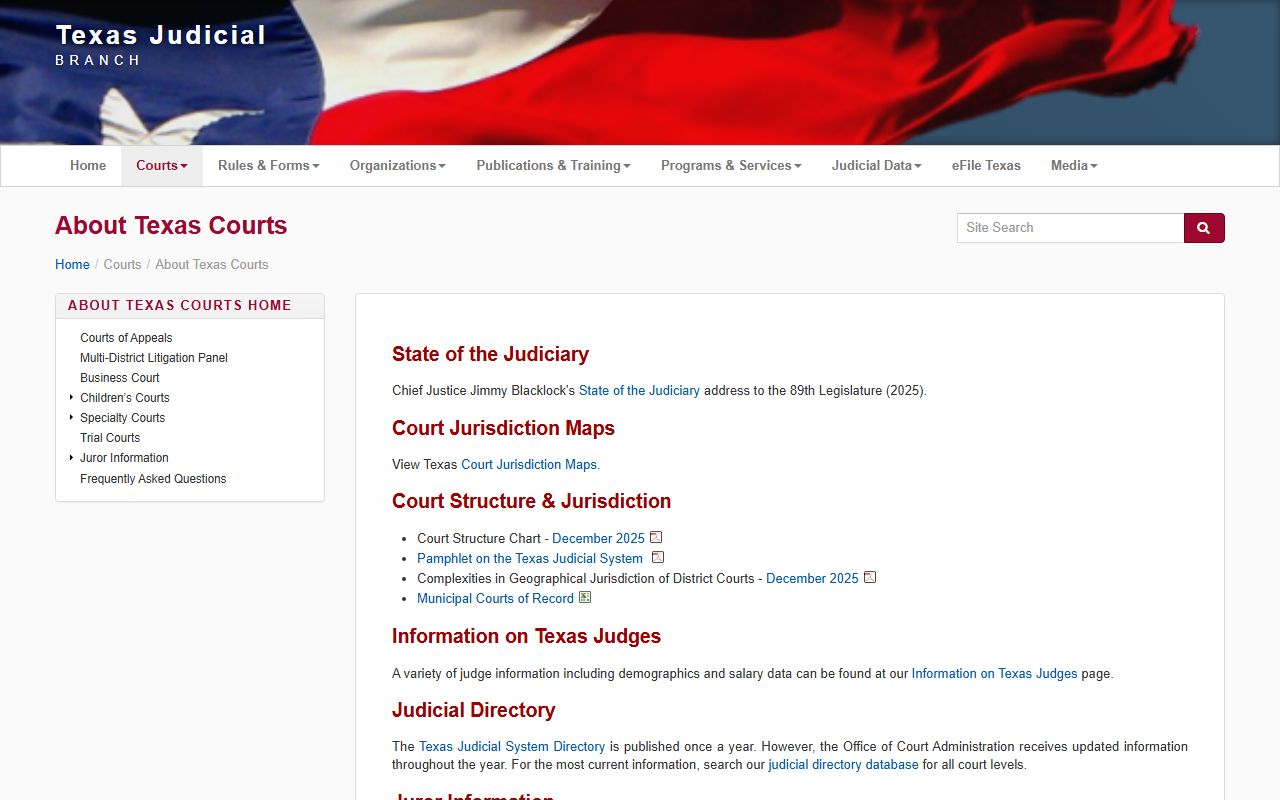
That overview from the Texas Courts site mirrors the local split between district, county, and justice courts in Lubbock County.
Case flow: Justice Court › County Court at Law › District Court › Court of Appeals
| Court | Jurisdiction | Case Types |
|---|---|---|
| District Courts (6) | General trial court | Felony, civil, family, divorce |
| County Courts at Law (3) | Limited statutory court | Misdemeanor, civil, probate, appeals from JP |
| Justice of the Peace (4) | Local limited court | Small claims, eviction, traffic, Class C |
| Municipal Courts | City court | City ordinance, fine-only traffic |
The District Clerk supports the six district courts and the three county courts at law for listed functions. The County Clerk keeps county civil, criminal, probate, and real property records. More detail sits on the Lubbock County District Court page.
Lubbock County Courthouses
Court and clerk business in Lubbock County runs from one downtown building. The Lubbock County Courthouse at 904 Broadway holds the district courts, the county courts at law, the justice courts, the District Clerk, the County Clerk, and the District Attorney. General court hours are 8:00 AM to 5:00 PM, Monday through Friday, with a noon closure. Jail custody and inmate visits are not here. Those happen at the Lubbock County Detention Center on North Holly Avenue. Federal court is also separate, near downtown on Texas Avenue.
Lubbock County Detention Center
3502 N. Holly Avenue
Lubbock, TX 79403
806-775-7009
The county judiciary directory lists each court, clerk, and department in the downtown building.
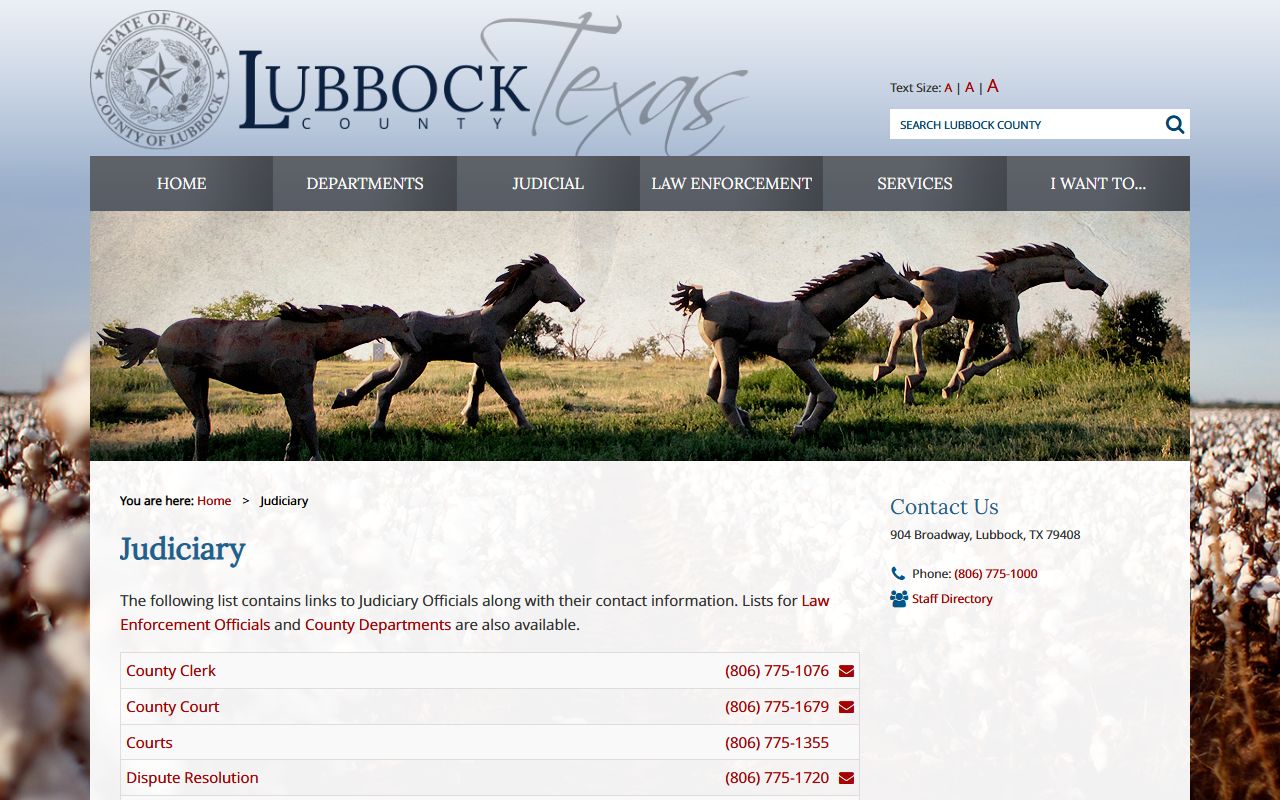
That judiciary page gives the phone and office details for the courts that produce Lubbock County court records.
Types of Court Records Available in Lubbock County
Lubbock County court records cover many case types, and the office that holds each file depends on the court. District courts make felony, civil, and family records. County courts at law make misdemeanor, civil, and probate records. Justice courts make small civil, traffic, and Class C records. Each clerk indexes its own files and sets its own copy rules.
Here are the main record types you can look for in Lubbock County.
- Criminal records - felony cases at the district courts and misdemeanors at the county courts at law.
- Civil records - lawsuits, debt, and property disputes filed with the clerks.
- Family and divorce records - divorce, custody, and support cases held by the District Clerk.
- Probate records - wills, estates, and guardianships held by the County Clerk.
- Traffic records - tickets and fine-only offenses heard in the JP precincts.
For a deeper walkthrough of each search, see the Lubbock County court records page and the court dockets page.
What Lubbock County Court Records Show
A court file is more than a verdict. Each case holds a docket, which is the dated log of every filing and event. The portal shows the case index, parties, attorneys, and settings. A full record adds pleadings, motions, orders, and the final judgment. The table below lists the common fields you will see in a Lubbock County court record.
| Field | What It Shows |
|---|---|
| Case Number | The cause number set by the clerk, such as DC-2023-CV-1234. |
| Filing Date | When the case was opened with the court. |
| Parties | Plaintiff and defendant, or petitioner and respondent. |
| Charges / Cause | The offense charged or the civil claim filed. |
| Disposition | The final outcome of a charge or case. |
| Sentence / Judgment | The penalty or the ruling the judge signed. |
Some fields are hidden by law. Social Security numbers, juvenile data, and sealed material do not show in public search results.
Public Access Laws for Lubbock County Court Records
Texas treats court records and agency records under different rules. Most government records fall under the Texas Public Information Act. Courts do not. The Texas judiciary states that courts are not subject to the Public Information Act for judicial records, and that Rule 12 governs judicial records other than case files. Court case records follow court rules, statutes, and the county's own electronic access policy.
A few statutes shape what stays open and what gets closed.
Key Statutes:
Texas Government Code § 552 - the Public Information Act, which sets the open-records rule for county and sheriff agency files.
Texas Rule of Judicial Administration 12 - governs public access to judicial records other than court case files.
Texas Code of Criminal Procedure Chapter 55A - the expunction law that can erase a qualifying arrest record.
Texas Government Code Chapter 411 - orders of nondisclosure that limit release of some criminal history.
More on the framework sits on the Lubbock County public records page.
Records That Are Restricted or Confidential
Not every court file is open. Texas law shields several kinds of records from public view. Juvenile justice files are restricted under Texas Family Code Chapter 58. Adoption records are confidential under Chapter 162. Expunged arrests are removed from public access, and nondisclosed records cannot be released to the public by criminal justice agencies. Sealed civil records follow Rule 76a. Victim identifying data, medical records, and Social Security numbers are also protected.
The state DPS explains how criminal history and registry rules work for the public.
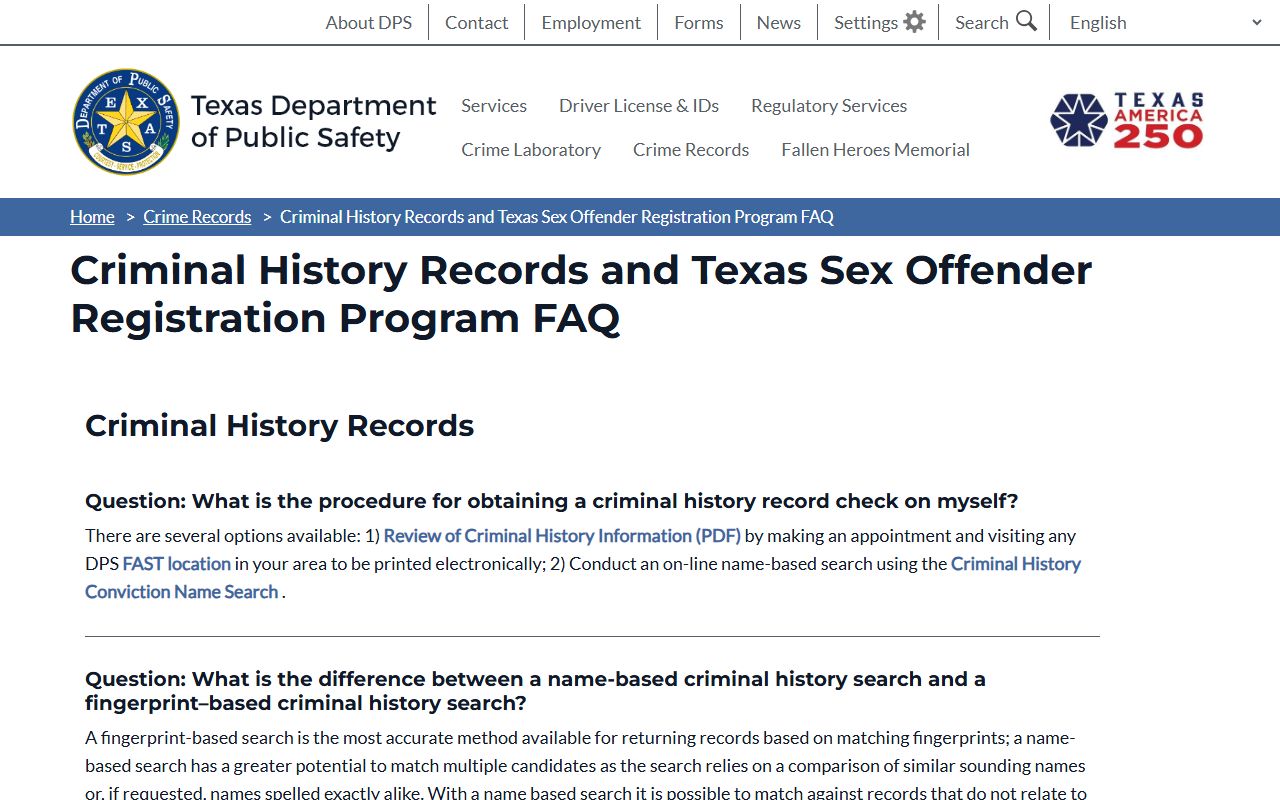
The DPS criminal history FAQ covers what stays open and what is closed after an expunction or nondisclosure order.
To view or unseal a restricted file, a person usually must file a motion in the proper court and show a legal basis. The District Clerk runs an expunctions line for these requests.
Specialty Courts in Lubbock County
Lubbock County runs specialty dockets that aim to fix the cause of repeat cases, not just punish them. A drug or treatment court works with people who have substance use issues, with screening, testing, and regular court reviews. A veterans treatment track coordinates with local veterans services. The sheriff's re-entry program names the Lubbock VA and VetStar as partners, which shows the local link between courts, jail, and treatment.
These dockets operate inside the district courts and county courts at law. Eligibility, plea status, and program length depend on the case and the judge. Check the courts page on the county site or call the District Clerk to confirm which docket fits a case.
Lubbock County Sheriff and Jail
Sheriff Kelly S. Rowe leads the Lubbock County Sheriff's Office, one of the largest law enforcement agencies in West Texas with more than 500 staff. The office runs a Law Enforcement Division and a Detention Division. The Lubbock County Detention Center on North Holly Avenue holds people booked on local charges. The sheriff posts an active jail roster, and you can look up an inmate by name, booking number, or SO number.
For the full roster details and booking process, see the Lubbock County inmate records page. For active warrants and the Most Wanted list, see the warrant records page. Release and re-entry questions are covered on the released inmates page.
Marriage, Divorce, and Probate Records
The County Clerk handles marriage licenses and records, and the office keeps probate and guardianship files. Divorce is a family case, so it lives with the District Clerk under the DC-year-FM format. For copies and search help, see the marriage and divorce records page and the probate records page. A few probate terms come up often.
- Testator
- The person who made a will.
- Executor
- The person named to carry out the will.
- Decedent
- The person who has died and whose estate is in probate.
- Guardian
- A person the court names to care for a ward or an estate.
Lubbock County Court Records Fees
Fees depend on which clerk holds the file and what you ask for. The County Clerk charges a flat fee for a certified marriage copy. The District Clerk charges per page for archive certified copies after a short wait. Probate filings carry set court costs. The table below lists common fees pulled from official county fee schedules.
| Item | Amount |
|---|---|
| Certified copy of marriage license | $21.00 |
| District Clerk certified copy (after five business days) | $1.00 per page |
| Original probate filing | $462.00 |
| Small estate / initial guardianship filing | $389.00 |
| Citation for posting | $8.00 each |
Pay the County Clerk by cashier's check or money order for mailed marriage copies. The office does not take personal checks.
How to Interpret Lubbock County Court Records
Court files use short codes and legal terms that can confuse a first-time reader. A charge is not the same as a conviction. An arrest only means a person was booked. A disposition shows the real outcome, such as a guilty plea, a dismissal, or a not guilty verdict. A capias is a court order to arrest, often after a missed date. Knowing the case-number format also helps. District Clerk numbers read DC-year-CV for civil, DC-year-FM for family, and DC-year-CR for felony cases. Always read the disposition before you judge a case.
Accuracy and Record Limitations
Online data can lag. A new filing, a plea, or a release may take time to post. The portal also leaves out document images and some restricted files. When a date, a charge, or an outcome matters for a legal or personal decision, confirm it with the clerk who holds the file.
Note: Always verify a name, date, or disposition with the District Clerk or County Clerk before you rely on any online Lubbock County court record.
History of Lubbock County Courts
Lubbock County sits on the South Plains of West Texas, with the city of Lubbock as its county seat and regional hub. The county has grown fast, from 278,831 residents in 2010 to an estimated 328,906 in 2025. Its oldest active court is the 72nd District Court, which dates to 1914. The 99th District Court followed in 1927, and later courts were added as the caseload grew.
The Handbook of Texas gives background on the county and its role as a regional center.

That Handbook of Texas entry notes Texas Tech University and the medical and trade economy that drive much of the county's court caseload.
Frequently Asked Questions
How do I search Lubbock County court records online?
Use the county's Online Access to Court Records page and register at the Public Access portal. County Clerk and District Clerk records are online now, and JP records are planned. Registered users see the case index, parties, attorneys, and scheduling data, but not document images.
Can I see court document images online?
For a standard public user, no. The county says document images are not in the registered portal. Use the public-access computers at the courthouse, or ask the District Clerk or County Clerk for a copy.
Which clerk holds my case?
District courts and felony, civil, and family cases route through the District Clerk. County criminal, civil, probate, and marriage records sit with the County Clerk. JP cases stay with the precinct court.
More answers are on the Lubbock County Court Records FAQ page.