
What Lubbock County Probate Records Cover
Probate is the court process that settles a person's estate after death. It proves a will, names someone to manage the assets, pays debts, and passes what is left to the heirs. When there is no will, the court still steps in to sort out the estate. Probate records hold the paper trail of all of this. They show who died, who applied, what the court ordered, and how the estate closed out. In Lubbock County these files also include guardianship and management trust matters, which protect minors or adults who cannot handle their own affairs.
In Lubbock County, probate and guardianship are handled through the County Clerk. The County Clerk lists Probate and Guardianship as a department, and the probate line is 806-775-1067. By Texas statute, the County Courts at Law hear probate matters in this county, and the County Clerk keeps the file. So the clerk indexes the case, takes the filing fee, issues citations, and stores the orders the judge signs.
This is different from divorce or felony files. Those route through the District Clerk. Probate stays with the County Clerk. Knowing that split saves time.
Probate Terms Defined
Probate filings use words you may not see day to day. A quick guide helps you read a case file or talk to the clerk. The terms below come up in most Lubbock County probate records, and a few apply to guardianship cases instead of estates.
- Testator
- The person who made the will. When that person dies, the will is offered to the court for probate.
- Executor
- The person named in a will to carry it out. The court grants this person letters testamentary so they can act for the estate.
- Intestate
- Dying without a valid will. The court then names an administrator and the estate passes under state law, not a will.
- Guardianship
- A court setup where one person is given legal authority to care for another person, called a ward, or that ward's estate, when the ward cannot do so.
- Conservatorship
- A court arrangement that gives one person legal control over the property or care of another who cannot manage it. In Texas estate practice this role often takes the form of a guardianship of the estate.
Types of Lubbock County Probate Records
A probate case is not one document. It is a stack that grows as the case moves. Some files are short. A small estate affidavit can close a modest estate fast. Others run for years, like a dependent administration or a long guardianship. The County Clerk indexes each one and keeps the papers as the court receives them. Below are the main record types you will find in Lubbock County probate records.
- Application to probate a will and the order admitting the will to probate.
- Application for letters testamentary or letters of administration.
- Small estate affidavit for a modest estate with no will.
- Initial guardianship and later guardianship reports and physician certificates.
- Management trust filings and applications to open a safety deposit box.
- Citations, posting, and service documents issued by the clerk.
- Oaths, bonds, inventories, appraisements, accountings, annual reports, and final accountings.
Guardianship files carry extra papers. They can hold medical and physician certificates, capacity findings, and protected personal details about the ward. Those parts are not open the way an estate inventory might be.
How Probate Works in Lubbock County
Probate follows a set path, though not every case hits every step. A small estate skips much of it. A contested will or a full guardianship runs the whole route. The steps below show how a typical Lubbock County probate matter moves from the first question to the final accounting. The County Clerk plays a role at filing, citation, and record keeping, while the court handles hearings and orders.
- Find out whether there is a will and whether probate is even needed.
- Pick the right applicant and the right type of case, such as independent administration, dependent administration, muniment of title, small estate, or guardianship.
- Prepare the application and any citation or service papers the case calls for.
- File with the County Clerk probate and guardianship office and pay the filing fees.
- The clerk issues a citation, posting, or other service as the case requires.
- The court sets a hearing when one is needed.
- The judge signs an order, and the executor, administrator, or guardian qualifies by oath and bond if required.
- The personal representative files an inventory or affidavit, then handles creditor notices, claims, assets, and distributions.
- Guardianships need ongoing reports and accountings and may carry more confidentiality than a routine estate.
Each step can add a document to the file. That is why an open estate may show many entries over time.
How to Search Lubbock County Probate Records
Remote search runs through the county's Public Access system. The County Clerk's records, including civil, criminal, and probate court cases, are part of that system. You register a free account first, then search by court or by name. The portal returns case index data, parties, and case details. It does not give document images to a standard registered user. For an actual will, order, or full file image, you use an on-site terminal at the courthouse or ask the custodian. That two-track setup matters for probate, since the document itself is often what you really need.
- Open the County Public Access portal and create a free registered account.
- Choose the County Clerk records, since probate and guardianship live there.
- Search by the decedent or ward name, or by a case number if you have one.
- Review the case index, the parties, and the case details the portal returns.
- For a will, an order, or any document image, use a courthouse public-access terminal or ask the clerk for a certified copy.
The county posts the official probate filing fee entry in its document center, which is a good check before you file or request copies.
You can confirm the current probate fees on the official probate filing fee document-center entry before a trip downtown.
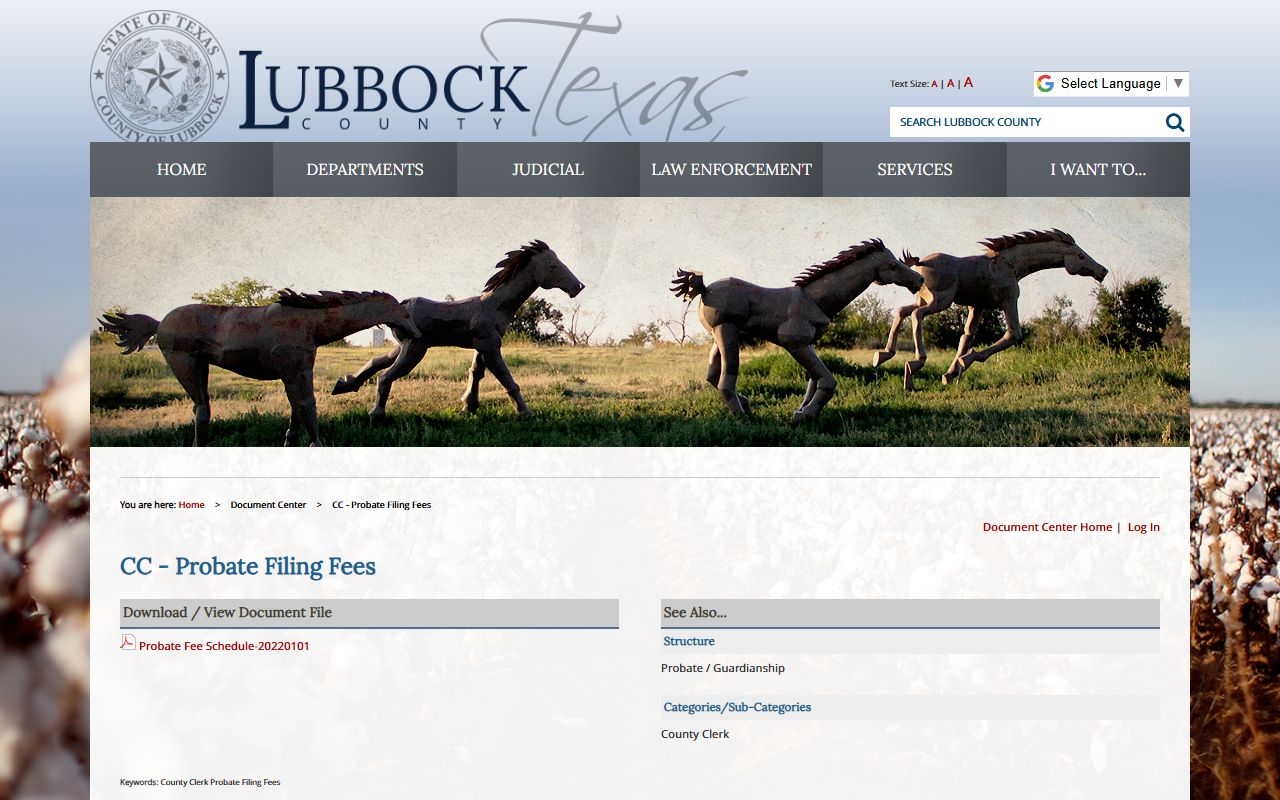
That document-center entry links the official probate fee schedule the County Clerk uses for Lubbock County probate records.
Probate Search Fields
The portal asks for a few core inputs for a probate search. The table lists what the county describes for registered public access to its court records.
| Field Label | Type | Required | Notes / Format |
|---|---|---|---|
| Portal account | Account | Yes for remote search | County Public Access registration required. |
| Court / location | Selection | Unspecified | County Clerk records are available. |
| Case number | Text | Optional | Exact probate format is not exposed online. |
| Party / decedent name | Text | Optional | Expected for a probate search; exact labels are not exposed. |
| Document images | N/A | N/A | No images for standard users; use an on-site terminal or the custodian. |
County Clerk Probate Office
The County Clerk runs the probate and guardianship desk for Lubbock County. The office sits in the courthouse downtown, in Room 207. Kelly Pinion is the County Clerk. The general office line and the probate line are different, so use the probate number for estate and guardianship calls. The office will not run searches that are not authorized by statute, so plan to use the portal or come in for a record. Lobby hours run from 8:30 in the morning to 4:30 in the afternoon, Monday through Friday.
Lubbock County Clerk - Probate
904 Broadway, Room 207
Lubbock, TX 79401
806-775-1067
Mon-Fri 8:30 AM - 4:30 PM
Mailed requests should go to P.O. Box 10536, Lubbock, Texas 79408. For records and copy questions, the County Clerk also lists an email and a copies line on its online-access page.
Lubbock County Probate Filing Fees
Probate filings carry set court costs. The County Clerk uses a probate fee schedule that took effect on January 1, 2022. The total for an original probate filing bundles several smaller charges, such as local and state consolidated court costs, a court fund fee, and citation and judge fees. A small estate, an initial guardianship, a management trust, or an application to open a safety deposit box uses a lower total. The table below lists the fees from the county probate schedule.
| Item | Amount |
|---|---|
| Original filing of probate, total | $462.00 |
| Small estate / initial guardianship / management trust / safety deposit box, total | $389.00 |
| Local probate consolidated court costs | $223.00 |
| State probate consolidated court costs | $137.00 |
| JADRS | $27.00 |
| Citation for posting | $8.00 each |
| Posting service by sheriff or constable | $65.00 |
| Judge's fee / signature fee | $2.00 |
| Small estate recording fee | $26.00 first page; $4.00 each additional page |
Citation for personal service also runs $8.00 each. Fees can change, so check the current schedule with the clerk before you file.
Note: The probate fee schedule took effect on January 1, 2022, so confirm any amount with the County Clerk before you send a filing or a payment.
What Lubbock County Probate Records Show
An estate file tells the full story of how property moved after a death. Early on, it shows the application and the order admitting a will, if there is one. It names the executor or administrator and shows the oath and bond. As the case runs, the file adds the inventory of assets, the appraisement, and any creditor notices. Near the end, it shows accountings and the final distribution to heirs. A reader can trace who got what and when the court signed off.
Guardianship files show a different mix. They hold the application, the order naming the guardian, and ongoing reports. They also carry medical and physician certificates and capacity findings about the ward. Much of that personal and medical detail is protected, which limits what shows up in a public search. For broader case context, you can cross-check the Lubbock County court records system that indexes County Clerk cases.
Confidential Probate and Guardianship Details
Not all of a probate file is open. Guardianship cases carry the most sensitive material. Physician certificates, capacity information, and other protected personal details about a ward are shielded from open public view. Estate files can also hold data that the clerk redacts, such as Social Security numbers. So a public search may show that a case exists and who the parties are, while the medical and personal pages stay closed.
The standard registered portal does not return document images for a regular user anyway. That alone keeps many sensitive pages off a remote screen. To see a protected document, a person usually needs a proper legal interest and may have to ask the clerk or the court. When a record matters for a legal step, confirm access rules with the County Clerk first. Marriage and divorce files follow their own rules and live elsewhere, which you can read on the marriage and divorce records page.