
Active Warrants in Lubbock County
A warrant is a court order. It tells law enforcement to act, often to arrest a named person or to search a place. In Lubbock County, warrants do not all come from one court. The four Justice of the Peace precinct courts may issue search and arrest warrants. They also run preliminary hearings and handle some emergency protective orders. District courts and county courts at law can issue warrants in felony and misdemeanor cases. So an active warrant could trace back to any of these courts, depending on the charge.
There is one hard truth here. Lubbock County does not run a single public website where anyone can type a name and pull up every active warrant. That gap is real, and it shapes how a search works. Instead of one tool, you use several. The Sheriff Most Wanted page highlights some sought people. The jail roster shows who was already booked. The court records show capias and bench warrant entries in cases that are public. Each tool covers a slice, not the whole.
The sheriff publishes a Most Wanted page that features people being sought in the county.

The Most Wanted list uses an embedded wanted-content area and carries an emergency disclaimer, so it is a tip and lookout tool rather than a full warrant database.
Where Lubbock County Warrants Come From
Five sources hold pieces of warrant information in Lubbock County. None of them is a complete public warrant index. Each one answers a different question. One shows who is wanted. One shows who is jailed. Others tie back to the court that signed the order. The table below lays out each source and what it can do for a search.
| Search Source / Field | Type | Use | Notes |
|---|---|---|---|
| Most Wanted embedded list | iframe / list | See featured wanted people | Official sheriff page has an embedded wanted-list area; no open form fields are exposed in the text. |
| Jail roster name | Text | Check current custody | Use to see if a person is now jailed after a warrant arrest. |
| Jail roster booking number | Text | Look up a known booking | For a person with a known booking number. |
| Jail roster SO number | Text | Look up by SO number | For a person with a known Sheriff's Office number. |
| Court portal case number | Text | Find warrant or capias entries | Search a case for warrant or capias docket events if the case is public and not sealed. |
The SWAT team handles the most dangerous end of this work. The sheriff's site notes that SWAT members are assigned full time to a Warrants Division. They specialize in serving high-risk felony warrants, which keeps routine warrant questions separate from tactical service.
The Warrants Division role is described on the sheriff's SWAT page.

That SWAT page explains that full-time members of the Warrants Division focus on executing high-risk felony warrants in Lubbock County.
Types of Lubbock County Warrants
Texas uses several kinds of warrants, and the name tells you a lot. Some start a criminal case. Some enforce a court order. One is built just for unpaid fines. Knowing the type helps you guess which court signed it and how to resolve it. A warrant is not a verdict. It is a step, and many warrants get recalled once the person responds.
- Arrest warrant - issued after a judge finds probable cause that a person committed an offense.
- Search warrant - authorizes a search of a place, property, or person for evidence.
- Bench warrant / capias - issued by a court after a missed appearance, contempt, an unpaid judgment, a probation violation, or another order.
- Capias pro fine - a common tool in fine-only cases after a judgment when the fine and costs go unpaid.
- Fugitive warrant - based on a warrant from another county or another state.
- Sealed warrant or indictment - not public until it is executed or unsealed by the court.
A Justice of the Peace may also handle an emergency protective order. That order is not the same as a warrant, but it can flow from the same JP precinct after an arrest. The Lubbock County Justice of the Peace courts cover this work across four precincts.
Lubbock County Warrant Terms
Court paperwork uses words that trip up first-time readers. A short glossary clears up the most common ones. These terms show up on case dockets, citations, and notices tied to Lubbock County warrants.
- Probable cause
- The legal standard a judge applies before signing an arrest or search warrant.
- Capias
- A court order to arrest, often issued after a missed court date or a broken condition.
- Capias pro fine
- A warrant used in fine-only cases when a person does not pay the fine and court costs.
- Bond
- Money or a surety promise that lets a person stay out of jail while a case moves forward.
- Recall
- The act of withdrawing a warrant after the person responds, pays, or appears.
- Fugitive warrant
- A hold based on a warrant from another county or state.
How to Search Lubbock County Warrants
Because there is no single public warrant portal, a smart search uses each tool in turn. Start with the source that fits your question. If you think someone may be jailed, check the roster first. If you want to know whether a court issued a capias, search the case. If you are looking for a featured wanted person, the Most Wanted page is the place. Do not lean on third-party warrant sites. They are often wrong or out of date.
- Open the Sheriff Most Wanted page and review the featured wanted people for the county.
- Check the active jail roster by name, booking number, or SO number to see if the person is already in custody.
- Search the case in the Lubbock County Public Access portal by case number to spot any warrant or capias docket entry, if the case is public.
- For the exact court that signed the order, call the District Clerk or County Clerk, or the JP precinct on a citation.
- For any felony or serious matter, talk to a lawyer before you take further steps.
Statewide criminal history is a separate path. The Texas Department of Public Safety runs a name-based criminal history search that can show conviction and some arrest data, though it is not a live warrant feed.
The state DPS offers an online criminal history name search for the public.
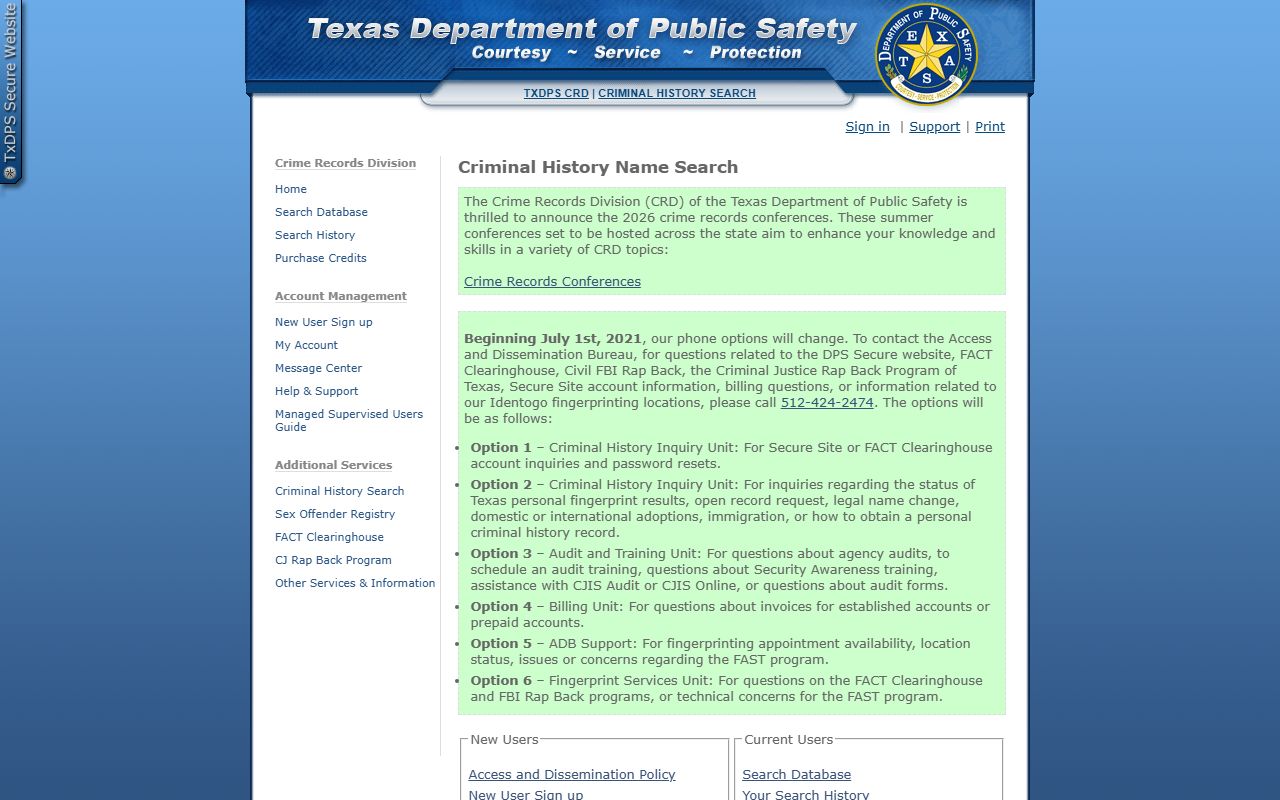
The DPS Criminal History Name Search is a paid, account-based tool that can supplement a Lubbock County warrant check, not replace the issuing court.
What a Lubbock County Warrant Record Shows
When a warrant or a capias appears in a public court case, the docket entry holds the core facts. The exact layout depends on the court and the system. Still, most warrant records carry the same kinds of data. The list below shows the common fields tied to a Lubbock County warrant entry.
| Field | What It Shows |
|---|---|
| Warrant / Capias Number | The number the court or agency assigns to the order. |
| Issue Date | When the judge or court signed the warrant. |
| Warrant Type | Arrest, search, bench, capias, capias pro fine, or fugitive. |
| Charge / Cause | The offense or the court reason behind the order. |
| Bond Amount | The bond set, if any, to secure release. |
| Issuing Court | The district court, county court at law, or JP precinct that issued it. |
| Status | Whether the warrant is active, served, or recalled. |
The jail roster ties into this too. If a warrant arrest has happened, the Lubbock County inmate records page can confirm custody and show the booking. The roster will not list every open warrant, only people already booked.
How to Resolve an Outstanding Warrant
An open warrant does not fix itself. It can lead to an arrest at a traffic stop, at home, or at work. The right move is to act on your own terms, with good advice. Many warrants, like a capias pro fine or a failure-to-appear, get recalled fast once you deal with the underlying case. Felony warrants are different and need a lawyer. The steps below follow the path the county and the courts point people toward.
- Do not rely on third-party warrant sites. They can be wrong, stale, or misleading.
- Contact the court listed on your citation or case notice, or search the official court records by case number.
- For JP, Class C, or traffic matters, contact the right JP precinct or the city municipal court.
- For felony or misdemeanor court warrants, contact the District Clerk or County Clerk, or hire an attorney.
- If an arrest is likely, consult counsel before you appear or turn yourself in.
- Ask whether bond can be posted, whether a court appearance is required, and whether the warrant recall will be sent after payment or after an order.
- Confirm clearance directly with the issuing court, since databases can lag behind the real status.
Important: Talk to a lawyer before you turn yourself in on a felony warrant, since the bond, the charge, and the timing all affect your options.
Using the State DPS for Records
The Texas DPS search has rules. It runs on a registered account, and it charges per search with a credit balance. It returns criminal history, not a live warrant list, so treat it as background, not as proof a warrant is cleared. The state explains the steps, the cost, and the account setup on its instructions page. Read those before you spend money on a search.
The DPS posts detailed instructions for how its criminal history search works.
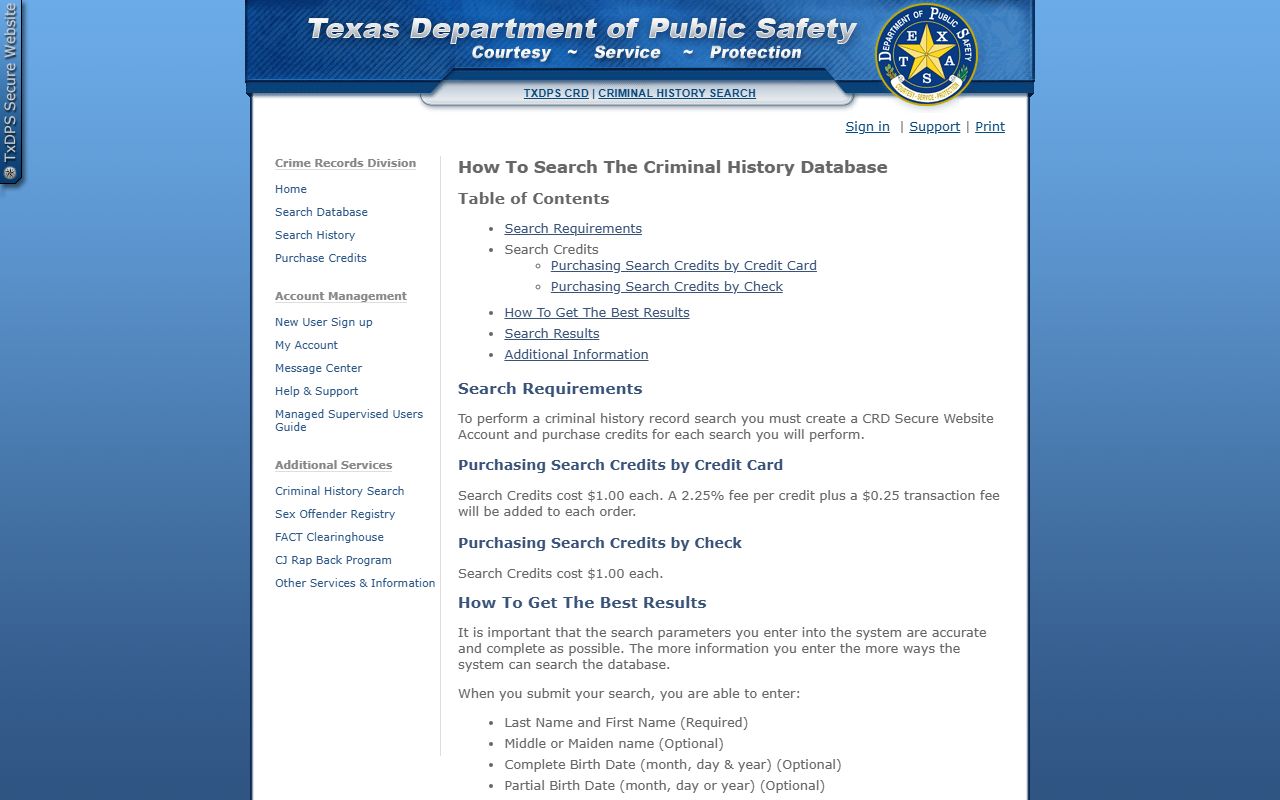
The DPS About page spells out the account and credit requirements before you run a Lubbock County background search.
Note: A clean DPS criminal history report does not prove a warrant has been recalled, so always confirm warrant status with the court that issued it.
The Texas Sex Offender Registry
Some searches start with a warrant question but really aim at a safety check. The state runs a public sex offender registry for that purpose. It is not a warrant tool. It shows registered offenders by name and area, with address and offense data where the law allows. People often pair it with a warrant or arrest check when they want a fuller picture of a person.
The state DPS hosts the public registry search.
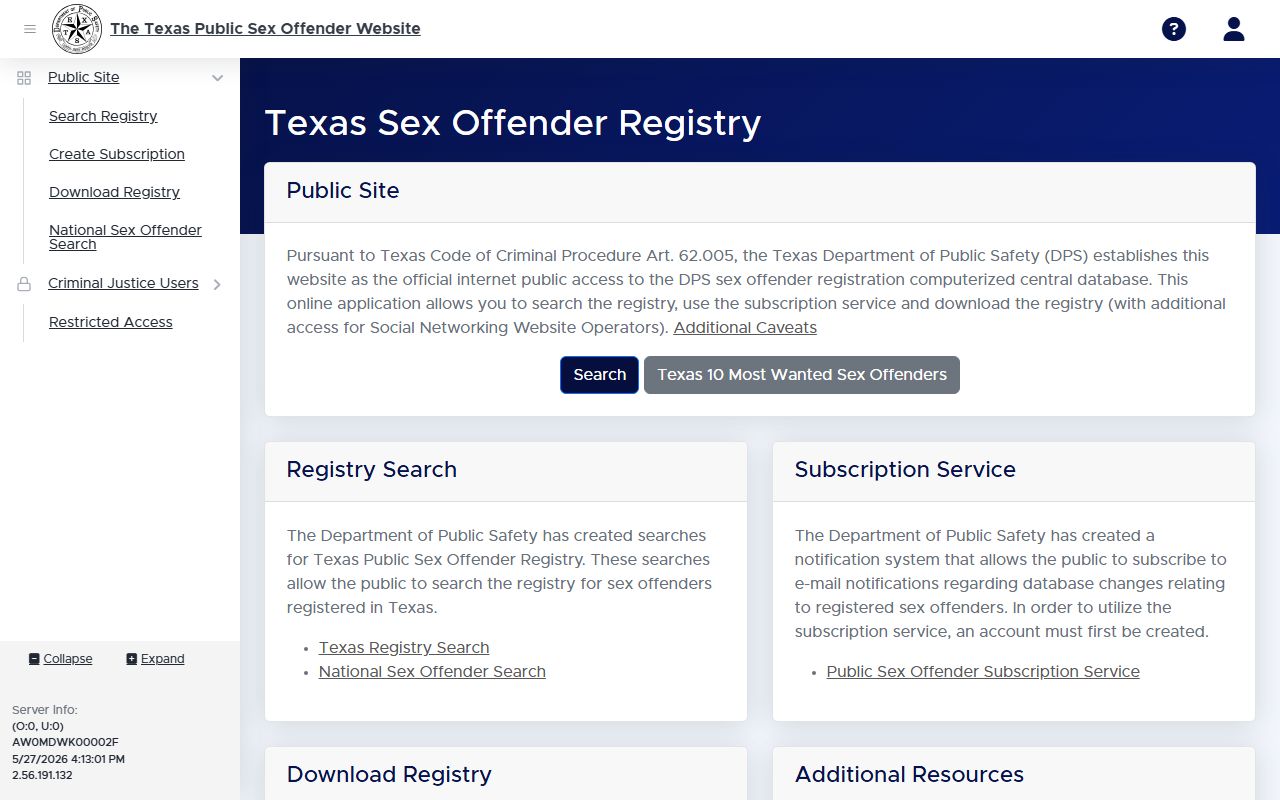
The Texas DPS sex offender registry is a separate public tool that some users check alongside a Lubbock County warrant or arrest search.
Restricted Lubbock County Warrants
Not every warrant is public. A sealed warrant or a sealed indictment stays hidden until it is served or the court unseals it. This protects an active investigation and keeps a target from fleeing. Grand jury work is secret by nature, and an indictment becomes public only when it is filed or unsealed. So a search may turn up nothing even when a warrant exists.
Juvenile warrants follow tighter rules. Texas Family Code Chapter 58 limits access to juvenile justice information, and that limit covers many juvenile court orders. Federal warrants are another layer. They live in the federal system, not the county roster, and they are tracked through the U.S. courts and the U.S. Marshals. For more on what stays closed, the DPS criminal history FAQ covers expunction and nondisclosure effects on public records.
Sealed civil and protected victim data can also block a record. The point is simple. A blank result is not always proof that no warrant exists. When the stakes are real, confirm with the court, not with a website.